As a child, I learned about art (painting) from the illustrated pages of the Petit Larousse dictionary (and sculpture under the statue of Jean Jaurès speaking to the glassmakers and miners in the square, the 19th-century bronzes flattering physical labor for the workers and maternal duty for their wives in the alleys of the Marquis de Solage park, and the plaster saints in the Saint-Privat church in Carmaux).
As a teenager, I persevered by buying tiny 12-page books at random at the newsagents: Impressionism, Cubism, Expressionism, Pointillism, Manet, Braque, Picasso, Léger, etc.
Paintings were reproduced in half-page black and white. The bottom half-page was devoted to brief explanations. When I felt I had understood everything, I moved on to practical exercises by enlarging works on Raisin-sized paper, using gouache, and inventing colors…
My father, convinced of my genius, saw no drawbacks to this chromatic freedom!
Quite quickly, I moved on to oil painting on canvas, where I invented my own works, « in the style of. »
Around the age of 19, I bought Pierre Francastel’s « Peinture et société » in a bookstore: a quantum leap!
As a teenager, I persevered by buying tiny 12-page books at random at the newsagents: Impressionism, Cubism, Expressionism, Pointillism, Manet, Braque, Picasso, Léger, etc.
Paintings were reproduced in half-page black and white. The bottom half-page was devoted to brief explanations. When I felt I had understood everything, I moved on to practical exercises by enlarging works on Raisin-sized paper, using gouache, and inventing colors…
My father, convinced of my genius, saw no drawbacks to this chromatic freedom!
Quite quickly, I moved on to oil painting on canvas, where I invented my own works, « in the style of. »
Around the age of 19, I bought Pierre Francastel’s « Peinture et société » in a bookstore: a quantum leap!
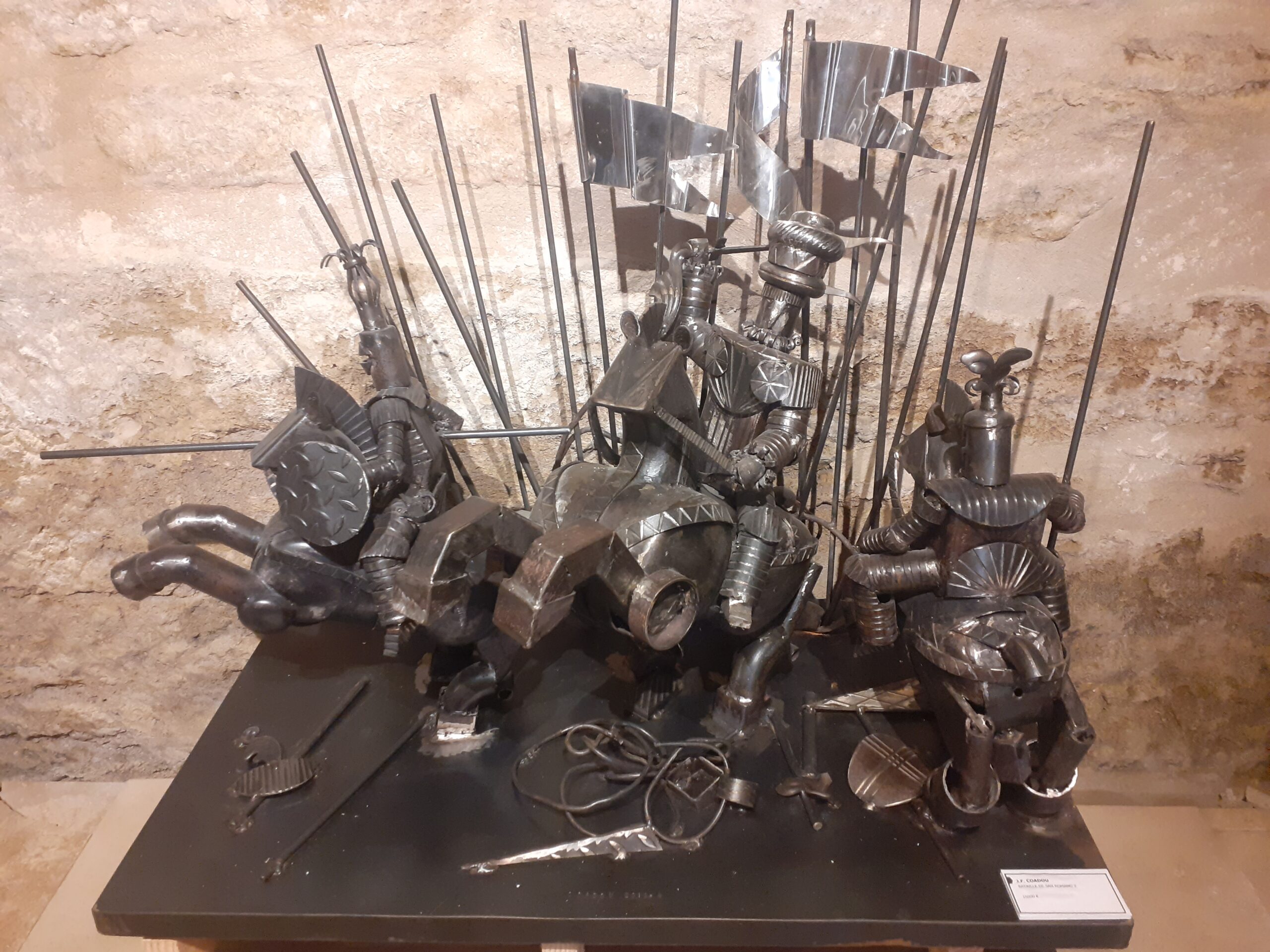
It was in this book that I discovered Paolo Uccello and one of his three paintings dedicated to the Battle of San Romano (the one in London, called the Battle of San Egidio).
But always in black and white!
Always in black and white, but no matter, I didn’t ask for that much; the main thing was the text.
Francastel’s text deals with the successive systems of representing space from the Middle Ages to the early 20th century.
Ucello painted his battles in the Quatrocento period, when the fledgling cavalier perspective was trying to replace the previous solutions. He is still a prisoner of traditional modes and, at this pivotal moment, attempts to experiment with something else…
It’s a theater scene where we are certain that the horses, all identical, are made of wood and walk on the boards in front of a stage curtain serving as a backdrop indicating the location of the event: the hills of San Romano where, in total indifference to History in the making, the peasants are hunting rabbits.
Moreover, it’s not a religious subject from which Renaissance artists were beginning to free themselves. Phew!
Before reading this book, I had been curious about Cubist modes of representation, as they challenged the laws of perspective by depicting an object simultaneously from several angles, and Futurist modes of representation, which introduced speed.
But always in black and white!
Always in black and white, but no matter, I didn’t ask for that much; the main thing was the text.
Francastel’s text deals with the successive systems of representing space from the Middle Ages to the early 20th century.
Ucello painted his battles in the Quatrocento period, when the fledgling cavalier perspective was trying to replace the previous solutions. He is still a prisoner of traditional modes and, at this pivotal moment, attempts to experiment with something else…
It’s a theater scene where we are certain that the horses, all identical, are made of wood and walk on the boards in front of a stage curtain serving as a backdrop indicating the location of the event: the hills of San Romano where, in total indifference to History in the making, the peasants are hunting rabbits.
Moreover, it’s not a religious subject from which Renaissance artists were beginning to free themselves. Phew!
Before reading this book, I had been curious about Cubist modes of representation, as they challenged the laws of perspective by depicting an object simultaneously from several angles, and Futurist modes of representation, which introduced speed.
The laws! The laws of perspective!”
I wasn’t aware at the time that cavalier perspective (a monocular view of a man on horseback) wasn’t natural at all times, but that this mode of representation was invented by Quatrocento artists in a humanist revolution of thought that no longer placed God at the center of the Universe.
I wasn’t aware at the time that cavalier perspective (a monocular view of a man on horseback) wasn’t natural at all times, but that this mode of representation was invented by Quatrocento artists in a humanist revolution of thought that no longer placed God at the center of the Universe.